Thursday, July 23, 2009

Lanazrote


Lanzarote is different, not only compared to the other islands, but to everything else on this planet. This extraordinary landscape seems to be of another world, and the inhabitants of the islands use to say that God forgot of Lanzarote on the Seventh Day of the Creation.

Lanzarote is of volcanic origin, as the other islands of the archipelago as well, but here volcanos have been active still in 18th and 19th century. Great parts of its surface are covered with ashes and lava, making you feel that you were on the moon.

Anyhow, Lanzarote's inhabitants made a great effort to cultivate this land, and today you find large plantations of fruits and vegetables. Most surprising is perhaps the region of Geria, with vineyards between volcanic craters.

Not to forget about are also the works of great Canarian architect and artist Cesar Manrique, adding more attractions to this unique island.


In the Island's South, the best known beaches of Lanzarote

Las Playas del Sur

Those great beaches of fine sand stretch over a length of 20 kilometers, between the island's Southern extreme to the airport.

Playa Blanca
:
An excellent beach with tropical ambience and outstanding installations for relaxing holidays.

Las Coloradas,
Small bays and turquoise sea, great for sports fishing.

Punta del Papagayo
Beautiful landscape and finest sand of golden color.

Playa Quemada
A very beautiful part of the coast with opulent vegetation; small appartment-houses with gardens.

Puerto del Carmen
A thermal spa in tropical surroundings, with a wide beach.

Playa Grande
Another very nice beach.

Playa de los Pocillos I
mpressive volcanic landscape and a small settlement in typical style.

The Small Islands,
Paradises in the Ozean

La Isleta
This small island with tropical vegetation and great possibilities for any kind of water-sports is particularly recommandable for diving and fishing.

La Isla Graciosa,
Paradisiac lonely beaches, ideal for those who prefer to avoid mass-tourism.

The Coast of Teguise,
the most "authentical" Lanzarote The part of coast close to the island's former capital, with its unusual landscape of volcanic origins, offers great beaches, as San José, Reducto and Guacimeta. Here you find some of Lanzarote's best hotels and holiday appartments.


This island which has been destroyed so many times by its volcanos' elemental forces and were reborn again, shows some of the most incredible landscapes you may find on this planet, opulent vegetation next to bizarre forms of petrified lava. As the island is not very large, you can explore most of it in a day's excursion by car:

Tahiche:
Wide extensions of black ashes at the foot of a uniquely bizarre mountain. The picturesque white houses of the village make an outstanding contrast to that. Close to Taiche are located the Casas Honda, volcanic caves that have been habited by the Maxos also called guanches, the original inhabitants of the islands

In Guatiza
you will find an enormous sea of cactuses. The reason of the existence of those plantations is because in the past they were used to produce a red pigment which was highly valuated. This pigment was won from insects living in the cactuses.

La Cueva de los Verdes
An incredible system of caves, of 7 kilometers length, which connects the volcano Corona with the sea. Inside those caves you will experience optical delusions (due to reflections) of the most surprising kind. In the past the island's inhabitants used the caves to hide up from the pirates. For invaders the Cueva de los Verdes frequently was a deadly trap. Of particular interest for biologists will be a species of animal that exists exclusively here: the Langostino Blanco, a lobster of white color which is perfectly adapted to those caves' life conditions.

Los Jameos del Agua

A very special part of Cueva de los Verdes. Canarian artist Cesar Manrique created here a complex that combines the miracles of nature with miracles of architecture: here you will find swimming-pools, restaurants and even a ballroom.

El Mirador del Rio
is a bizarre rock of 600 meters height, face to face to the island Graciosa, which offers an outstanding panoramic.

Valle de Haria
is a beautiful valley with an extension of 150 km2, offering surprising canyons of volcanic origins, palm-forrests and a very picturesque small village.

La Geria: In this spectacular landscape with thousands of small volcanic craters you can see some of the world's most unusual vineyards: in small pits filled with volcanic ashes and surrounded by stonewalls are growing the grapes of Canary Islands' most famous wine, Malvasía

In Los Hervideros
we find picturesque forms of petrified lava.

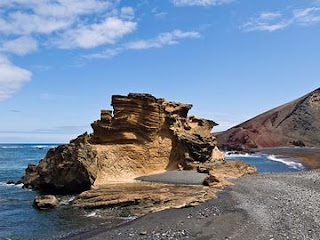
El Golfo
is a volcanic crater flooded by the sea. It is beautiful to see the emerald green water contrasting with the black sand.


This National Park, with an extension of 200 km2, seems to confront us with an apocalyptical vision: this land was born of hundreds of fire-spitting volcanos.

It is easy to arrive to by car, because it seems that all ways on Lanzarote lead to here. Through the park itself you either move by bus (each quarter of an hour, between 9 a.m. and 6 p.m. in summer and 9 a.m. and 5 p.m. in winter, respectively), or you choose the by far more adventurous alternative and rent a ... camel!

In or on your preferred transport medium you will traverse a sea of petrified lava and volcanic ashes. Some of the craters of the volcano Montaña de Fuego ("Mountain of Fire") are still active, and just centimeters from the surface temperature arrives to some 400ºC. If you put water on a crater, it will vaporize in a fraction of a second, and if you put small branches there, they will start to burn immediately. . In some of the Restaurants in Timanfaya you even can have your steak grilled on a volcanic crater.

After such a kind of lunch you certainly will be still more receptive for the miracles that nature has done here.

The last great volcanic out-break on Lanzarote was, by the way, in 1732, when large parts of the island were destroyed. In 1824 some smaller craters broke out again.

Lanzarote-Photos


Fuertevenura

The Beaches of Fuerteventura

Beaches of Jandia and Sotavento, paradise for divers and friends of nudism

Between Pajara and Jandia you will find an almost untouched beach of a length of 6 kilometers. Golden sand, crystalline sea and a colorful world under water which magically attracts divers. Just in front of the beach are cruising fishing-boats, as great amounts of fish have to pass this narrow channel between the island and Africa. This beach is one of the less crowded of all the islands (parts of it are not accessible by car), so also the friends of nudism feel particularly well here.

Beach of Corralejos,
crystalline sea Corralejos is a pittoresque fishing-village in the very north of the island. Fine sand and crystalline water make its beaches some of the most beautiful of the archipelago. Also the romantical village itsself is well worth a visit, and from here you may have an excursion by boat to the nearby island Lobos

Lobos Island,
the lonely paradise Surprising but true. Just a few kilometers from the most modern complexes of tourism, you find this lonely island, inhabited just by a handful of fishermen. This is a really great place for all the "Robinson Crusoes" among us.


FUERTEVENTURA: The Old Land

Fuerteventura, the island with the oldest history, has the longest beaches of all the archipelago, of wonderful fine sand.
Only a narrow channel separates Fuerteventura from the African continent. It is a paradise equally for spending holidays at the beach as for fishing.

There are great beaches even very close to the islands capital, Puerto Rosario.
Fuerteventura is an ideal destination for surfers (the island has an important place on the windsurfing World Cup circuit) and for diving fans, thanks to the caves, tunnels, overhangs and rock formations to be found on its ocean beds.


Betancuria:
back to the roots This town, named after French conquerer Bethencourt, is located in the very center of the island.
This land is particularly fertile, which may be the reason why the island's original population, the Guanches, founded their first important settlement here. In the town's Archaeological Museum you can see highly interesting remains of this original civilization.
As well interesting is the artistically very valuable Cathedral, built in 1410, with beautiful works in Mudejar-style and painted choir-stalls of the wood of the canarian pine.

More Photos for Gran Canaria


Wednesday, July 22, 2009

Gran Canaria

GRAN CANARIA: The Small Continent

that is how this island is called because of its extremely varied landscapes with European, African and even American vegetation. The mountain range in the island's center, of a height of about 2000 meters, is cut by some bizarre canyons.Hardly anywhere else you can find such different landscapes and even climatical zones being geographically that close one to each other: mountain massives, desert land, tropical forrests, ... Along the seaside there are wide beaches of sand, and while elsewhere people are shuddering of cold, here the tourists are lying in the sun and looking at those mountainpeaks being covered with snow ...

The Beaches of Gran Canaria

Maspalomas
Maybe the most beautiful among the fantastic beaches of this island. Fine white sand at a length of 6 kilometers and a width of up to 1 kilometer, and intensely blue sea ... a paradise for sunworshippers, in particular during the cold European winter! There are modern hotel-complexes and sports installations, more than anywhere at Faro de Maspalomas, with the island's most important sports harbour, Pasitoblanco. Along the beach there are several oasis with palms and even a fresh-water lake.

Playa del Inglés
Next to Maspalomas, of a length of 2.700 meters. This is one of the most famous beaches of the archipelago, with modern hotels and installations of any kind

San Agustín
Less known than the two foregoing, but quieter and more relaxing. An ideal place to recover from the stress of everyday life.Playa de Patalavaca: Another great beach with fine sand of golden color. Also ideal for sport-fishing.

Puerto Rico
A modern urbanization with hotels, appartments and a nice harbour. Its great sports installations are one of its main attractions.

Costa de Bañaderos
Beautiful landscape with romantical small bays.

Galdar
with a bizarre high coast.

Sardina del Mar
a picturesque fishing-village with nice beaches.

Playa de las Canteras
a wide beach of sand at 2,6 kilometers length, located directly in the capital, Las Palmas de Gran Canaria.

Playa de las Nieves
Nieve means snow in Spanish language, and this name comes from the high mountains directly behind this beach.


Las Palmas de Gran Canaria, an original town
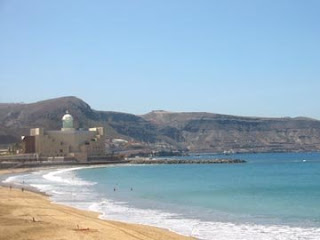

The archipelago's capital, with 352.641 inhabitants, surprises the visitor with its highly original and individual architecture showing influences of all five continents, and its colorfully painted houses.
Ambience is very lively, being evidence of a population of southern temperament not always taking life at its most serious.This city's great cultural offer, attractive festivities and highly recommendable cuisine, as well traditional and regional as international, will make your stay memorable.
Don't miss ...
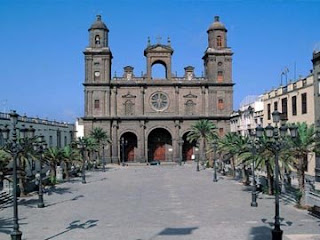
The Cathedral
of gothic and neoclassical style. Its construction was begun after the discovery of America. At the same square, Santa Ana, you'll find also the Archiepiscopal Palais and several nice buildings in the typical Canarian style of architecture.
The Barrio de la Vegueta is a very attractive quarter of town, with numerous manorial houses showing influences of latin-american colonial style.
In the Centro Atlántico de Arte Moderno you can see an important collection of contemporary art.
La Casa de Colón,
the "House of Columbus", reminds us that the ships of Christopher Columbus made a halt here on their journey to America.
The Museo Canario,
the "Canarian Museum", shows the most complete exposition you may find about the islands' original inhabitants, the Guanches.
The Pueblo Canario,
located in the beautiful gardens of Doramas Park, was created by canarian artist Néstor de la Torre and represents the islands' typical architecture. Each Thursday and Sunday take place colorful folkloristical performances.
More sights to be visited are the Museum of Arts, the Museum Pérez Galdós in the house where this writer was living, and the Nestor-Museum, close to the Pueblo Español and created by the artist himself.8 kilometers out of Las Palmas there is the Jardín Canario, the "Canarian Garden". It shows the incredible variety of plants at the islands, with no fewer than 500 species existing exclusively here.


The Guanches were the original inhabitants of Canary Islands.
The word comes from Guan Chenech, which is how the natives of Tenerife called themselves in their own language. With the passage of time, the term Guanche became identified with the natives of the all the Canary Islands.
This population of white skin and tall figure is a mystery to historians. In the Canarian Museum of Las Palmas you will find a collection of some of the most interesting findings, but Guanches have left their tracks in all the island:
Galdar, here is located the Cueva Pintada, a cave with polychrome geometrical wall-paintings. The Arbol Sagrado, a very old tree in front of the town-hall, was one of this population's sanctuaries.
Telde:
this village, which is worth a visit alone for its beautiful landscape and great beaches, has in its surroundings one of the most interesting tracks of the Guanches as an additional attraction: the Montaña Sagrada, the "Holy Mountain", together with several caves which were habited by this population.
San Bartolomé de Tirajana:
You can arrive to this village which is "hidden" in an enormous volcanic crater only by narrow mountain streets, passing the island's highest mountains, Pozo de las Nieves (1.965 m) and Los Pechos (1.961 m). Close to it there is the Guanche's Necropolis of Artenara.
Temisas:
another romantical small village with fine beaches, offering interesting historical remains as an additional attraction.
In Malpais,
located close to Agaete, were made very important archaeological findings


The impressive landscape around Tejeda was called "the petrified storm" by Spanish writer Unamuno.
You find here green valleys with cultures of almonds at the foot of the mighty mountain peaks Roque Nubo and Bentayga.
Teror The village which "seems to be floating in the air", is located at a tableland 575 meters above sea level.
It is surrounded by breath-taking mountain ranges. It is also a well-known place of pilgrimship and has several very nice houses in colonial style, as the Casa de Doña Teresa de Bolivar .
Arucas: This well cared-for old town with nice parks is located at an impressive high coast with picturesque small bays, and some of the island's most important banana-plantations. Very close to here there is the volcano Montaña de Arucas
Santa María de Guia
is located in the island's north. Here you may visit the Cenobio de Valerón, a group of caves enclosed by petrified lava.
At Agaete, located at the seaside, you can see an impressive canyon with plantations of papayas, avocados, coffee and bananas, and the Balneario de los Berrazales with its thermal springs.
In the south we find the most beautiful landscapes at Arinaga, which is a romantic fishing-village offering a great panorama, and Mogán, a beautiful valley with cultures of tropical fruits.


Canary Island

CANARY ISLANDS: The Happy Islands


This paradisiac group of islands, enjoying a wonderful climate, with a constant mild temperature through all the year, and splendid beaches of fine sand, consists of 7 larger islands (Gran Canaria, Fuerteventura, Lanzarote, Tenerife, La Palma, La Gomera and El Hierro) and a few smaller ones (Alegranza, Graciosa, Montaña Clara, Roque del Este, Roque del Oeste and Lobos). Surprisingly, the landscape of each island is radically different to the others.

Already Greeks and Romans reported on this archipelago of volcanic origins, and called it the Happy Islands, Garden of the Hesperides, Atlantida, ... Some historians suppose that the legendary continent Atlantis was located here. The islands' original population, commonly called Guanches, is tall and of white skin.In 1496 the islands became part of the Spanish kingdom, and the ships of Christopher Columbus stopped here on their travel to discover the New World.

The Canary Islands are located in the Atlantic Ocean, south-west of Spain and north-west of Africa. They are directly in front of the coast of Morocco. Due to this geographical situation, the Canary Islands have been always an important station for the navigation between Europe, Asia and America.