Showing posts with label Canary Island. Show all posts

Friday, July 24, 2009

El Hierro

EL HIERRO: Small Unknown Island
El Hierro is the most westerly and the smallest island of the archipelago.

The island has the UNESCO Biosphere Reserve designation and is home to natural swimming pools and crystal clear waters, ideal for swimming and scuba diving, as well as huge areas of protected woodland in the inland area.

All those reasons made el Hierro an ideal place to make relaxing holidays in direct contact with nature

Its steep rocky coast is very different from the wide beaches which are dominating on the Canary Islands, though we find here as well a beach of 14 kilometers length, at Golfo.

From the central tableland, with volcanic craters and nice woods, and its highest peak, Malpaso (1.501 m.), you will have a great panorama.


Valverde
Valverde, the capital of El Hierro, is the only capital on Canary Islands which is not located at the coast, but in a mountaneous region with an altitude of 600-700 meters.

The town consists of steep and narrow streets, whitewashed houses with typical architecture, and generous gardens.

The most remarkable sight of Valverde is the church Santa María de la Concepción dating from 18th century, with sculptures of great artistic interest. The city hall, which faces the church, is a fine example of the traditional architecture of Canary Islands


El Hierro: Excursions
In the north of the island there is Tamaduste, offering a beautiful natural basin with crystalline water

In Monacal we find luxuriant vegetation and two large natural basins at the coastline. Next to them, you can admire Pozo de las Calcosas, an old settlement formed by stone houses with straw roofs.

The viewpoint Mirador de la Peña offers a phantastic panorama on the west of El Hierro, and there are also great views from the small village Tiñor, which is located on a tableland in the interior.

In the center of El Hierro there is La Frontera, in English the frontier: this village is cut off from the rest of the island by mountains which are over 1000 meters high. This region is reknown for its wine and fruit production, and it is an ideal place to enjoy the gastronimical highlights of El Hierro: excellent wines, smoked cheese, and quesadillas.

El Pinar, surrounded by thick woods, is a charming white village with fertile grounds and a milde climate. The mountain Montaña de Tanajara, located nearby, invites you to enjoy great views over the volcanic landscapes in the south and the woods in the center of El Hierro. It is also well-known for its beautiful sunsets.

In the area of Malpaso, the highest elevation of the island (1.501 meters above sea level) there are untouched woods and you may enjoy the phantastic panorama.

The spa Sabinosa in the west is perhaps one of the most picturesque and beautiful villages: it is located at a precipice directly over the sea, at an altitude of about 300 meters, and impresses us with its typical whitewashed houses in the traditional style.

In the forest of El Sabinal you will find trees almost bent double by the wind

La Restinga, in the south of El Hierro, is an ideal resort for divers and fishers. It offers crystalline water and an authentic ambience.

La Gomera

LA GOMERA: Island of Mountains
This island is characterised by its central massif of a height of 1487 meters, dropping steeply to the sea. The region of Alto de Garajonay was declared a National Park.

Particularly interesting are the population's very old and original popular customs. The inhabitants of the different valleys use to communicate with each other in a whistling language, comparable to the "yodling" in Central European Alps


San Sebastian de la Gomera
At this picturesque small town connected to Tenerife by a ferry-boat, Christopher Columbus made halt on his travel to America.

He received help of Doña Maria de Bobadilla, the widow of Grafen Peraza, to repair one of his ships, La Pinta.

Many things in San Sebastian remind of those happenings still today, such as the as the Church Iglesia de N.Sra de la Asunción and the port from which Columbus left. Of the Count's fortress, however, only a tower, the Torre del Conde, is conserved .


The Beaches of La Gomera
Here we find mostly small bays with fine sand, in the island's steep coast

Playa de Santiago a picturesque small fishing-village with a fine beach and crystalline water.

At the exit of Valle Gran Rey a valley with important plantations, is located one of the island's best beaches.

Playa de Vallehermoso, another fine beach close to Acantilado de los Organos


La Gomera-Photos


La Palma Island


LA PALMA: The Beautiful Island
La Palma, also called the "green island" because of its exuberant countryside was declared a Biosphere Reserve by the UNESCO.

It's major sight is the National Park Caldera de Taburiente with its huge volcanic crater, 9 kilometres wide and 770 meters deep From the view-point Mirador de la Cumbrecita this terrific natural monument can be overlooked best.

At the edge of the Caldera de Taburiente National Park there is the island's highest mountain, Roque de los Muchachos (2426m). In the municipality of Garafía, at 2396 m. above sea level, you can get to know an important astrophysical observatory with one of the most ample and modern equipments of telescopes to be found anywhere in the world. The Instituto de Astrofísica de Canarias organises visits for colleges and groups as part of a public campaign to make astronomy accessible to everyone.


Santa Cruz de la Palma
At the island's east-coast is located this picturesque port-town. Behind it, like a colossal amphitheater, there is the mighty volcanic crater la Caldereta.

This town, with its characteristical steeply inclined alleys, offers a really lively ambience

Among the most important sights there are the Town Hall and the church Iglesia del Salvador, both of 16th century, and the interesting Museum of Natural Science.

A few kilometers out of town is located the Santuario de la Virgen de las Nieves, a sanctuary of the island's patroness.


La Palma: Excursions

Following the coast from Santa Cruz direction South, you arrive to Breña Baja, with some very beautiful small bays and great beaches of sand, as Playa de Cancajos

In Mazo, close to the airport, there is the Cueva de Belmaco, a cave with prehistorical engravings. From here you also have a great view over the coast.

In Fuencaliente you can enjoy of the unusual contrast of vineyards and volcanic craters. Best known are the craters of San Antonio and Teneguia the latter having erupted for the so far last time in 1971.

Puerto de Naos is a traditional fishing-village with splendid beaches of fine sand.

Also Tazacorte surrounded by large plantations of bananas, has a picturesque port and fine beaches to offer.

Over the beautiful valley of Los Llanos de Aridane is located the view-point El Time, from which you can overlook the National Park Caldera del Taburiente

Cueva Bonita, close to Tijarafe, is a beautiful grotto really deserving a visit.

Around San Andrés and Sauces there are large and beautiful woods.

Tenerife Island

TENERIFE: Island of Eternal Springtime

Tenerife is the largest of the Canary Islands, and also of volcanic origins. It is dominated by the 3718 meters high volcano Mount Teide with its mighty crater. The Teide is not only the highest mountain of all Spain, but also the mountain with the highest elevation in all the Atlantic Ocean.

At the sides of the montain range which crosses the island there are extremely fertile valleys with important plantations of bananas and tomatoes.

Tenerife's coastline is typically rugged and steep, however there are as well almost 70 kilometers of fine sand beaches, in particular in the islands' south, with Playa de las Americas and Los Cristianos among the best known.


The Beaches of Tenerife

Playa de las Americas,
being located at the island's south-eastern extreme, offers fabulous beaches of sand as well as the most modern infrastructure for tourism

Playa de los Cristianos:
fine beaches of golden sand and crystalline water, close to a picturesque fishing-village. Its outstanding infrastructure makes it one of the most attractive places for visitors

Playa de las Galletas:
at the island's southern extreme, with great hotel and sports installations. Punto de Rasca offers an outstanding panorama

Playa de El Puertito:
a 1,6 kilometers long beach of black sand, located close to the village Güimar.

Very close to it there is also Playa del Roque, another wonderful beach of black sand.

Playa de las Caletillas:
another center of international tourism, three marvelous small bays close to Candelaria.

Close to Santa Cruz there are the beaches Las Gaviotas, a small nudist beach with black sand, and Las Teresitas, a popular beach in the north of Tenerife with golden sand and palm trees.

In Puerto de la Cruz there is the famous Costa Martianez with its large artificial pond, Lago Martianez one of the most outstanding examples of coastal transformation combining elements of traditional Canary architecture with original sculptures and natural vegetation. It was created by the great architect Cesar Manrique, a native of Canary Islands.


Santa Cruz de Tenerife, The Shining Town
Santa Cruz de Tenerife is a very friendly town with 211.930 inhabitants. The first things to call your attention will be its beautiful parks, as Park García Sanabria, and its lively streets. Many cruisers from all the world touch at its picturesque port, which is surrounded by high rocks. The port area is the town's real center: Plaza de España, with its Cabildo Insular eat of the museums of archaeology and anthropology, and Plaza de la Candelaria with its impressive 17th. century Carta Palace.

More sights are the baroque church Iglesia de la Concepción, the Museum of Painting and Scultpure and the castle Castillo de Paso Alto.

Close to Santa Cruz there are the beaches Las Gaviotas and Las Teresitas, and a nice destination of an excursion might be the mountain Monte de la Esperanza, located at 20 kilometers from the town, offering an outstanding view over all the island.


Puerto de la Cruz: Beauty of the Island
Puerto de la Cruz is Tenerife's most visited site, and due to its favored climate one of the most visited towns of Spain all the year through. Its picturesque townscape alone makes it worth a visit, but there are many attractions more:

The famous Costa Martianez with its large artificial pond and most original sculptures. This outstanding example of coastal transformation combines elements of traditional architecture with natural vegetation and was created by the great Canarian architect Cesar Manrique.

Loro Park is another main attraction. Its name comes from the numberless parrots in those beautiful tropical gardens, but most impressive are certainly the spectacular performances of dolphins.

Highly interesting as well is the park Jardín de Aclimatación, between Puerto de la Cruz and Orotava, which was created in 18th century and offers a great variety of plants from all the world.

Worth visiting are as well the navigation museum Museo Naval de la Casa Iriarte, the fortress Castillo de San Felipe and the church Nuestra Señora de la Peña de Francia.


San Cristobal de la Laguna: The former capital

San Cristóbal de la Laguna was formerly the capital of Tenerife and has the most important university on Canary Islands.

This small town boasts numerous monumental buildings and has been declared a World Heritage Site by UNESCO.

La Laguna was founded in 1497 and the first houses were built around the church Iglesia de la Concepción, the oldest church of the island. In 1500 a concept for the further expansion of the town was developed, and it included philosphic principles as well as principles ruling the navigation of the epoch. This entire old town, with more than 600 buildings in the characteristic Mudejar-architecture, is conserved intact.

La Laguna claimed its greatest importance in the 17th and 18th century, when the town grew considerably.

Among the most important religious buildings of La Laguna, there are the church Iglesia de la Concepción (as already mentioned above), the church Santo Domingo, and the convents San Juan Bautista, Santa Catalina de Siena and Real Santuario del Cristo de La Laguna. Examples of civil architecture which have to be mentioned are the palaces Casas del Corregidor: Casa Alvarado Bracamonte, Casa Riquel, Palacio de Lercaro and Palacio de Nava.


Excursions on Tenerife

Tacoronte: This picturesque village is located at the edge of an impressive steep coast is also famous for its excellent red wines.

In Candelaria, a well known place of pilgrimship, is located the church consecrated to the island's patroness, Basílica de la Virgen de la Candelaria

La Orotava is an extraordinarily nice town with manorial houses in the island's traditional style. Particularly well-known are the Casas de los Balcones, 17th. century buildings with those typical balconies of Canarian pine-wood. The best time to visit Orotava is during the celebrations of Corpus Christi, when the streets are covered with earths of six different colors which are found in the surroundings and ornamented with innumerable flowers

The town is located in the really paradisiac valley Valle de la Orotava . When the peak of nearby Teide is still covered with snow flowers are in full bloom here. Scientist Alexander von Humboldt, after whom is named a viewpoint here, reported that he was on his knees in front of so much beauty when he visited Orotava.

Güimar, located in a valley, is surrounded with breathtaking canyons and large plantations of bananas. Here we find the Ethnographic Park Pyramids of Güímar a complex of six step-pyramids which are oriented astronomically to the summer and winter solstices. The pyramids have been discovered in 1987 and show great resemblance to those found in Egypt, ancient Mesopotamia, Peru and Mexico. The origins of the pyramids are still uncertain and subject to discussion among archeologists. In the opinion of the great explorer and anthropologist Thor Heyerdahl, who was involved in the early researches, they may have been constructed by voyagers who sailed the Atlantic in ancient times and possibly may have established a link with the pre-Columbian civilizations of Central and South America.

Close to Güimar there we find the small village Los Realejos, with the island's oldest church and several monuments of interest.

Icod de los Vinos is popularly called the "Town of the Mythological Dragon Tree". This mighty thousands of years old tree was a sanctuary of the Guanches who believed it had magic forces. The town itself is a nice settlement with buildings in colonial style and is well known for its wine production.

Garachico is a small village of unique beauty with a port that once has been the most important at the whole island. Close to it there are beaches of black sand with beautiful natural basins

Santiago del Teide shows an extraordinarily nice landscape with an impressive steep coast, the so-called Acantilados de los Gigantes


National Park El Teide
This National Park offers a fascinating landscape, created by the elemantar forces of the volcano Teide. Christopher Columbus observed its last great eruption in 1492 from the nearby island La Gomera, just before continueing his discovery travel to America. In 1798 there was another smaller eruption. The Teide has piled up some 12 million cubic meters of volcanic material at its sides, those formations being popularly called the Narices del Teide, "noses of Teide".

With a height of 3718 meters the Teide is not only the highest mountain of Spain but as well the highest elevation in all the Atlantic Ocean and worldwide the volcano with the third-highest elevation, behind Mauna Loa und Mauna Kea, both on the island of Hawaii. A cableway takes visitors up to 3600 meters. From there you may climb the peak by foot.

On clear days you have a fantastic view. But at least equally impressive is the volcano's immense crater. After previous agreement with the park's administration you may participate (by free!) at a visit. You will then enter the crater, first with a cross-country car, then by foot, until you arrive to still active parts of the volcano.

Around the Teide there are several other smaller volcanos, such as Montaña Chahorra (or "Pico Viejo"), with a height of 3100 meters and a crater with a diameter of 800 meters, and Montaña Rajada, which has great amounts of the black volcanic glass obsidian.

At the side of Teide there is a large flat country called Las Cañadas del Teide, having been used by the island's original population, the Guanches, as pastureland. Today it is covered with petrified lava having very bizarre forms, as the Roques de García and several caves, as Cueva del Hielo or Cueva de los Cazadores.

In this area exist some extremely rare species of plants, as the Guanche Rose, of which are known only some 50 exemplares worldwide, the Teide Violet and animals, in particular lizards.

Tenerife Island


Thursday, July 23, 2009

Lanzarote-Photos


Fuertevenura

The Beaches of Fuerteventura

Beaches of Jandia and Sotavento, paradise for divers and friends of nudism

Between Pajara and Jandia you will find an almost untouched beach of a length of 6 kilometers. Golden sand, crystalline sea and a colorful world under water which magically attracts divers. Just in front of the beach are cruising fishing-boats, as great amounts of fish have to pass this narrow channel between the island and Africa. This beach is one of the less crowded of all the islands (parts of it are not accessible by car), so also the friends of nudism feel particularly well here.

Beach of Corralejos,
crystalline sea Corralejos is a pittoresque fishing-village in the very north of the island. Fine sand and crystalline water make its beaches some of the most beautiful of the archipelago. Also the romantical village itsself is well worth a visit, and from here you may have an excursion by boat to the nearby island Lobos

Lobos Island,
the lonely paradise Surprising but true. Just a few kilometers from the most modern complexes of tourism, you find this lonely island, inhabited just by a handful of fishermen. This is a really great place for all the "Robinson Crusoes" among us.


FUERTEVENTURA: The Old Land

Fuerteventura, the island with the oldest history, has the longest beaches of all the archipelago, of wonderful fine sand.
Only a narrow channel separates Fuerteventura from the African continent. It is a paradise equally for spending holidays at the beach as for fishing.

There are great beaches even very close to the islands capital, Puerto Rosario.
Fuerteventura is an ideal destination for surfers (the island has an important place on the windsurfing World Cup circuit) and for diving fans, thanks to the caves, tunnels, overhangs and rock formations to be found on its ocean beds.


Betancuria:
back to the roots This town, named after French conquerer Bethencourt, is located in the very center of the island.
This land is particularly fertile, which may be the reason why the island's original population, the Guanches, founded their first important settlement here. In the town's Archaeological Museum you can see highly interesting remains of this original civilization.
As well interesting is the artistically very valuable Cathedral, built in 1410, with beautiful works in Mudejar-style and painted choir-stalls of the wood of the canarian pine.

More Photos for Gran Canaria


Wednesday, July 22, 2009

Gran Canaria

GRAN CANARIA: The Small Continent

that is how this island is called because of its extremely varied landscapes with European, African and even American vegetation. The mountain range in the island's center, of a height of about 2000 meters, is cut by some bizarre canyons.Hardly anywhere else you can find such different landscapes and even climatical zones being geographically that close one to each other: mountain massives, desert land, tropical forrests, ... Along the seaside there are wide beaches of sand, and while elsewhere people are shuddering of cold, here the tourists are lying in the sun and looking at those mountainpeaks being covered with snow ...

The Beaches of Gran Canaria

Maspalomas
Maybe the most beautiful among the fantastic beaches of this island. Fine white sand at a length of 6 kilometers and a width of up to 1 kilometer, and intensely blue sea ... a paradise for sunworshippers, in particular during the cold European winter! There are modern hotel-complexes and sports installations, more than anywhere at Faro de Maspalomas, with the island's most important sports harbour, Pasitoblanco. Along the beach there are several oasis with palms and even a fresh-water lake.

Playa del Inglés
Next to Maspalomas, of a length of 2.700 meters. This is one of the most famous beaches of the archipelago, with modern hotels and installations of any kind

San Agustín
Less known than the two foregoing, but quieter and more relaxing. An ideal place to recover from the stress of everyday life.Playa de Patalavaca: Another great beach with fine sand of golden color. Also ideal for sport-fishing.

Puerto Rico
A modern urbanization with hotels, appartments and a nice harbour. Its great sports installations are one of its main attractions.

Costa de Bañaderos
Beautiful landscape with romantical small bays.

Galdar
with a bizarre high coast.

Sardina del Mar
a picturesque fishing-village with nice beaches.

Playa de las Canteras
a wide beach of sand at 2,6 kilometers length, located directly in the capital, Las Palmas de Gran Canaria.

Playa de las Nieves
Nieve means snow in Spanish language, and this name comes from the high mountains directly behind this beach.


Las Palmas de Gran Canaria, an original town


The archipelago's capital, with 352.641 inhabitants, surprises the visitor with its highly original and individual architecture showing influences of all five continents, and its colorfully painted houses.
Ambience is very lively, being evidence of a population of southern temperament not always taking life at its most serious.This city's great cultural offer, attractive festivities and highly recommendable cuisine, as well traditional and regional as international, will make your stay memorable.
Don't miss ...
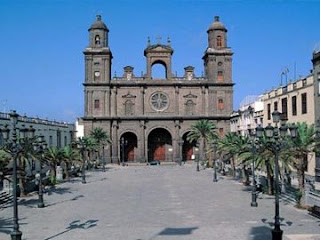
The Cathedral
of gothic and neoclassical style. Its construction was begun after the discovery of America. At the same square, Santa Ana, you'll find also the Archiepiscopal Palais and several nice buildings in the typical Canarian style of architecture.
The Barrio de la Vegueta is a very attractive quarter of town, with numerous manorial houses showing influences of latin-american colonial style.
In the Centro Atlántico de Arte Moderno you can see an important collection of contemporary art.
La Casa de Colón,
the "House of Columbus", reminds us that the ships of Christopher Columbus made a halt here on their journey to America.
The Museo Canario,
the "Canarian Museum", shows the most complete exposition you may find about the islands' original inhabitants, the Guanches.
The Pueblo Canario,
located in the beautiful gardens of Doramas Park, was created by canarian artist Néstor de la Torre and represents the islands' typical architecture. Each Thursday and Sunday take place colorful folkloristical performances.
More sights to be visited are the Museum of Arts, the Museum Pérez Galdós in the house where this writer was living, and the Nestor-Museum, close to the Pueblo Español and created by the artist himself.8 kilometers out of Las Palmas there is the Jardín Canario, the "Canarian Garden". It shows the incredible variety of plants at the islands, with no fewer than 500 species existing exclusively here.


The Guanches were the original inhabitants of Canary Islands.
The word comes from Guan Chenech, which is how the natives of Tenerife called themselves in their own language. With the passage of time, the term Guanche became identified with the natives of the all the Canary Islands.
This population of white skin and tall figure is a mystery to historians. In the Canarian Museum of Las Palmas you will find a collection of some of the most interesting findings, but Guanches have left their tracks in all the island:
Galdar, here is located the Cueva Pintada, a cave with polychrome geometrical wall-paintings. The Arbol Sagrado, a very old tree in front of the town-hall, was one of this population's sanctuaries.
Telde:
this village, which is worth a visit alone for its beautiful landscape and great beaches, has in its surroundings one of the most interesting tracks of the Guanches as an additional attraction: the Montaña Sagrada, the "Holy Mountain", together with several caves which were habited by this population.
San Bartolomé de Tirajana:
You can arrive to this village which is "hidden" in an enormous volcanic crater only by narrow mountain streets, passing the island's highest mountains, Pozo de las Nieves (1.965 m) and Los Pechos (1.961 m). Close to it there is the Guanche's Necropolis of Artenara.
Temisas:
another romantical small village with fine beaches, offering interesting historical remains as an additional attraction.
In Malpais,
located close to Agaete, were made very important archaeological findings


The impressive landscape around Tejeda was called "the petrified storm" by Spanish writer Unamuno.
You find here green valleys with cultures of almonds at the foot of the mighty mountain peaks Roque Nubo and Bentayga.
Teror The village which "seems to be floating in the air", is located at a tableland 575 meters above sea level.
It is surrounded by breath-taking mountain ranges. It is also a well-known place of pilgrimship and has several very nice houses in colonial style, as the Casa de Doña Teresa de Bolivar .
Arucas: This well cared-for old town with nice parks is located at an impressive high coast with picturesque small bays, and some of the island's most important banana-plantations. Very close to here there is the volcano Montaña de Arucas
Santa María de Guia
is located in the island's north. Here you may visit the Cenobio de Valerón, a group of caves enclosed by petrified lava.
At Agaete, located at the seaside, you can see an impressive canyon with plantations of papayas, avocados, coffee and bananas, and the Balneario de los Berrazales with its thermal springs.
In the south we find the most beautiful landscapes at Arinaga, which is a romantic fishing-village offering a great panorama, and Mogán, a beautiful valley with cultures of tropical fruits.


Canary Island

CANARY ISLANDS: The Happy Islands


This paradisiac group of islands, enjoying a wonderful climate, with a constant mild temperature through all the year, and splendid beaches of fine sand, consists of 7 larger islands (Gran Canaria, Fuerteventura, Lanzarote, Tenerife, La Palma, La Gomera and El Hierro) and a few smaller ones (Alegranza, Graciosa, Montaña Clara, Roque del Este, Roque del Oeste and Lobos). Surprisingly, the landscape of each island is radically different to the others.

Already Greeks and Romans reported on this archipelago of volcanic origins, and called it the Happy Islands, Garden of the Hesperides, Atlantida, ... Some historians suppose that the legendary continent Atlantis was located here. The islands' original population, commonly called Guanches, is tall and of white skin.In 1496 the islands became part of the Spanish kingdom, and the ships of Christopher Columbus stopped here on their travel to discover the New World.

The Canary Islands are located in the Atlantic Ocean, south-west of Spain and north-west of Africa. They are directly in front of the coast of Morocco. Due to this geographical situation, the Canary Islands have been always an important station for the navigation between Europe, Asia and America.